Managed OHS Compliance for South African Employers
Health and Safety compliance under the OHS Act 85 of 1993, delivered as a managed service. The software keeps your record current; our team does the work and a qualified human signs it off before it reaches you.
Available now. The OHS module is live and taking clients. POPIA is next, then Labour, CIPC, SARS and FICA.
What you actually see
Every requirement we track is separated into what the law requires and what is good practice, with the section or regulation named beside it. Nothing is asserted without a source.
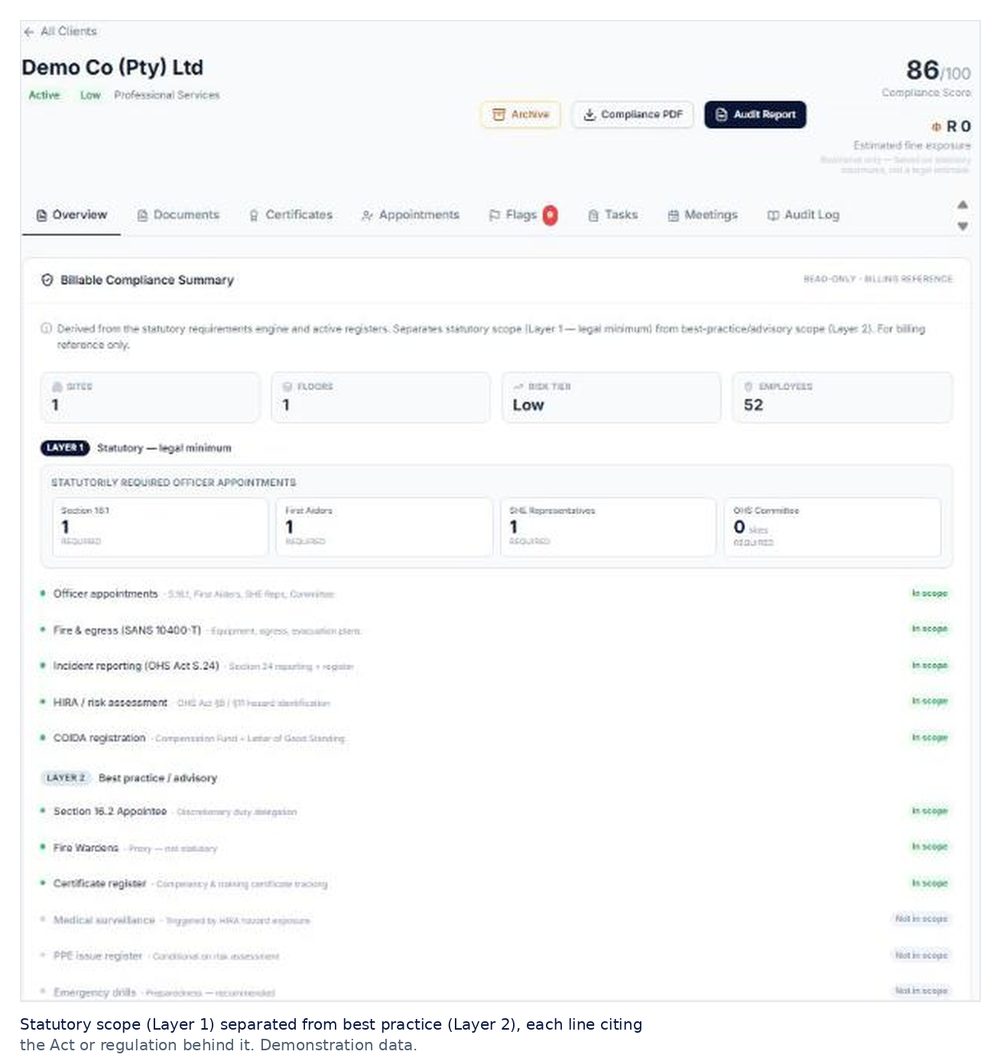
OHS compliance is a legal duty, not a filing exercise
Under the Occupational Health and Safety Act 85 of 1993, every South African employer must provide and maintain a working environment that is safe and without risk to health, as far as is reasonably practicable (Section 8). In practice that means more than a signed policy in a file: you need live hazard identification and risk assessment, the correct statutory appointments, current registers, and evidence you can produce when an inspector arrives.
Employers with more than 20 employees must designate health and safety representatives (Section 17), and establish health and safety committees where representatives are designated (Section 19). Workplace injuries are handled under COIDA. The OHS app keeps all of this current in one place.
What the OHS Act actually requires of an employer
Section 8(1) of the Occupational Health and Safety Act 85 of 1993 requires every employer to provide and maintain, as far as is reasonably practicable, a working environment that is safe and without risk to the health of employees. Section 8(2) then spells out what that covers: safe systems of work, eliminating a hazard before reaching for protective equipment, establishing what hazards attach to the work and what precautions are needed, information and training and supervision, and enforcing the measures that are necessary.
The phrase as far as is reasonably practicable is defined in section 1. It is not as far as is convenient. It weighs the severity and scope of the hazard, the state of knowledge about it and about the means of removing it, the availability of those means, and the cost of applying them against the benefit.
Section 37 is the provision that catches most employers by surprise. If an employee or a mandatary does something that would be an offence had the employer done it, the employer is presumed to have done it. The only escape is proving all three of the following: that you did not connive at or permit it, that it fell outside the scope of that person authority in any circumstance, and that you took all reasonable steps to prevent it. Issuing an instruction, on its own, is expressly not enough. That is why the evidence trail matters more than the intention.
Penalty exposure, stated accurately. Section 38(1) of the Act carries a fine not exceeding R50 000 or imprisonment not exceeding one year, or both. Section 38(2) raises that to R100 000 or two years where an act or omission caused injury in circumstances that would have been culpable homicide had death resulted. Individual regulations carry their own separate and higher penalties: the Major Hazard Installation Regulations, 2022 provide for R500 000 to R5 000 000 or up to 24 months.
Where several contraventions are charged, each is a separate offence carrying its own maximum, so exposure compounds. That is a modelled worst case and not a legal statement: the amounts in the Act are maximum penalties a court may impose on conviction, and an inspector cannot levy a fine directly. Be careful of any single headline maximum fine figure that does not name the instrument it comes from.
The five things a Department of Employment and Labour inspector asks for
Almost every general industry inspection works through the same five areas. Each one has a specific statutory anchor, a specific trigger, and a specific record it creates. Get these right and an inspection becomes an administrative exercise rather than an event.
1. Statutory appointments
Section 16(1) puts the duty on the chief executive officer. Section 16(2) lets the CEO assign those duties to a person under their control, and section 16(3) confirms that doing so does not relieve the employer of responsibility or liability. Beyond section 16, individual regulations create their own appointments, and the one most often missed in general industry is the supervisor of machinery.
Trigger: no headcount test for section 16. General Machinery Regulation 2(1) applies to any premises on or in which machinery is used, and requires a written full time designation. OHS Act s16, General Machinery Regulation 2(1)2. Health and safety representatives
Section 17(1) requires an employer with more than 20 employees at a workplace to designate representatives in writing, for a specified period, within four months. The nomination or election process must be agreed in good faith with registered trade unions, or with employees where there is no union. Employees nominate or elect, and the employer formally designates.
Trigger: more than 20 employees at that workplace. Ratio under section 17(5): at least 1 per 100 employees or part thereof in shops and offices, and 1 per 50 or part thereof in all other workplaces. OHS Act s17 and s18, General Administrative Regulations 6 and 73. First aiders and first aid boxes
General Safety Regulation 3(1) requires every employer to take all reasonable steps to ensure prompt first aid treatment. The box duty and the trained person duty then have different triggers, which is where most workplaces get it wrong. The requirement is that a certificated person is readily available during normal working hours, so shift coverage is part of it.
Trigger: first aid box at more than 5 employees. Certificated first aiders at more than 10 employees, then at least 1 per group of up to 50, or 1 per group of up to 100 in a shop or office. General Safety Regulation 3(2), 3(4) and 3(6)4. Health and safety committees
Section 19(1) makes a committee mandatory once two or more health and safety representatives have been designated for a workplace. Employer nominated members may not outnumber the representatives. The committee must meet at least once every three months, must discuss any incident in which a person was injured, became ill or died, and must keep a record of every recommendation it makes.
Trigger: two or more designated representatives. Meetings at least quarterly, and additionally where more than 10 percent of non-representative employees request one in writing. OHS Act s19 and s20, General Administrative Regulation 55. Incident reporting and investigation
Reporting and recording are two different duties. Reporting is the external notification to the provincial director. Recording is the internal Annexure 1 record, and it captures a wider set of events, including any incident where a person needed medical treatment other than first aid. An incident can be recordable without being reportable.
Report on WCL 1 or WCL 2 within 7 days, and forthwith by telephone or similar for death, unconsciousness, loss of a limb or likely permanent defect. Investigate within 7 days. Retain records at least 3 years. OHS Act s24, General Administrative Regulations 8 and 9And the one behind all five
Section 8(2)(d) requires the employer to establish what hazards attach to the work, the plant, the machinery, the articles and the substances, and what precautionary measures are needed. That is the statutory basis for the workplace risk assessment. Every appointment, ratio and register above is downstream of it, which is why a compliance programme that starts with letters rather than with the risk assessment tends to fall over under questioning.
OHS Act s8(2)(d)Headcount thresholds at a glance
The thresholds below count employees at a workplace, not across the business, so an employer with several sites assesses each site separately.
| Employees at the workplace | What is triggered | Anchor |
|---|---|---|
| Any number | Section 8 general duties, the risk assessment, and the section 16(1) chief executive officer duty. A supervisor of machinery must be designated in writing wherever machinery is used, regardless of headcount. | s8, s16(1), GMR 2(1) |
| More than 5 | A first aid box or boxes at or near the workplace, accessible to employees, containing at least the Annexure minimum contents. | GSR 3(2) and 3(3) |
| More than 10 | At least one person holding a valid first aid certificate of competency readily available during normal working hours, then 1 per group of up to 50, or 1 per group of up to 100 in a shop or office. | GSR 3(4) |
| More than 20 | Health and safety representatives must be designated in writing for a specified period, within four months, after good faith consultation on the nomination or election process. | s17(1) and s17(2), GAR 6 and 7 |
| Two or more representatives designated | One or more health and safety committees must be established, meeting at least once every three months, with records retained for at least three years. | s19(1), s19(4), GAR 5 |
The most common error we see. The ratio of one health and safety representative for every 20 employees is repeated widely, and it is not what the Act says. The number 20 is the threshold in section 17(1) at which the duty to have representatives begins. The ratio itself sits in section 17(5), and it is 1 per 100 or part thereof in shops and offices, and 1 per 50 or part thereof in all other workplaces.
Applying a richer ratio than the Act requires is perfectly legitimate, either because it was agreed under section 17(2) and General Administrative Regulation 6 or because an inspector directed it under section 17(6). It should just be described as the agreed ratio, not as the statutory minimum, because the two are not the same thing when a shortfall is being assessed.
What changed in 2025 and 2026, and what changes next month
Three regulation sets in this area were amended in 2025 and 2026, and one long standing set falls away shortly. Any OHS file, appointment schedule or policy that still cites the older instruments needs a review.
| Date | What changed |
|---|---|
| 6 March 2025 | The Physical Agents Regulations, 2024 and the Noise Exposure Regulations, 2024 were promulgated. The General Safety Regulations were amended on the same date, substituting regulation 2 and inserting new regulations 13H housekeeping, 13I precaution against flooding, and 13J fire precaution and means of egress. |
| 5 December 2025 | The General Safety Regulations were amended again. Regulation 3(4) now requires a first aid certificate of competency issued by an organisation approved by the chief inspector, with the previously named issuing bodies removed from the wording. Confirm that your training provider is currently approved rather than relying on its historical status. |
| 23 January 2026 onward | The Compensation for Occupational Injuries and Diseases Amendment Act 10 of 2022 came into operation in stages. Post traumatic stress disorder is recognised as an occupational disease, employer provided transport is brought into the course of employment, the claim prescription period moves from 12 months to three years, and from 1 April 2026 the criminal offence regime is largely replaced by administrative penalties. |
| 1 March 2026 | The maximum earnings on which a COIDA assessment is calculated moved to R668 000 per employee per annum, up from R633 168. |
| 6 September 2026 | The Environmental Regulations for Workplaces, 1987 are repealed by regulation 21 of the Physical Agents Regulations, 2024, and the Noise Induced Hearing Loss Regulations, 2003 fall away on the same date. Any document citing them for lighting, ventilation, thermal conditions, housekeeping, flooding or fire precautions needs rewriting against the new instruments. |
Still draft, not law. Replacement General Machinery Regulations were published for comment on 22 August 2025 and draft Construction Regulations on 12 March 2025. Neither has been promulgated, so the 1988 General Machinery Regulations and the 2014 Construction Regulations remain the operative law as at August 2026. An Occupational Health and Safety Amendment Bill proposing materially higher penalties has been circulated for comment in the past but has not been enacted.
What the GRC Shop OHS app manages
The OHS app is the live record for your health-and-safety obligations, aligned to the OHS Act and ISO 45001, with our team doing the work behind it.
What is included
- ISO 45001-aligned hazard register (HIRA), kept current
- Statutory appointments under the OHS Act 85 of 1993, with valid appointment letters
- COIDA tracking for workplace-injury compliance
- Incident workflow: capture, investigation and corrective actions
- Contractor management for third-party safety compliance
- Audit-ready registers and reporting you can produce on demand
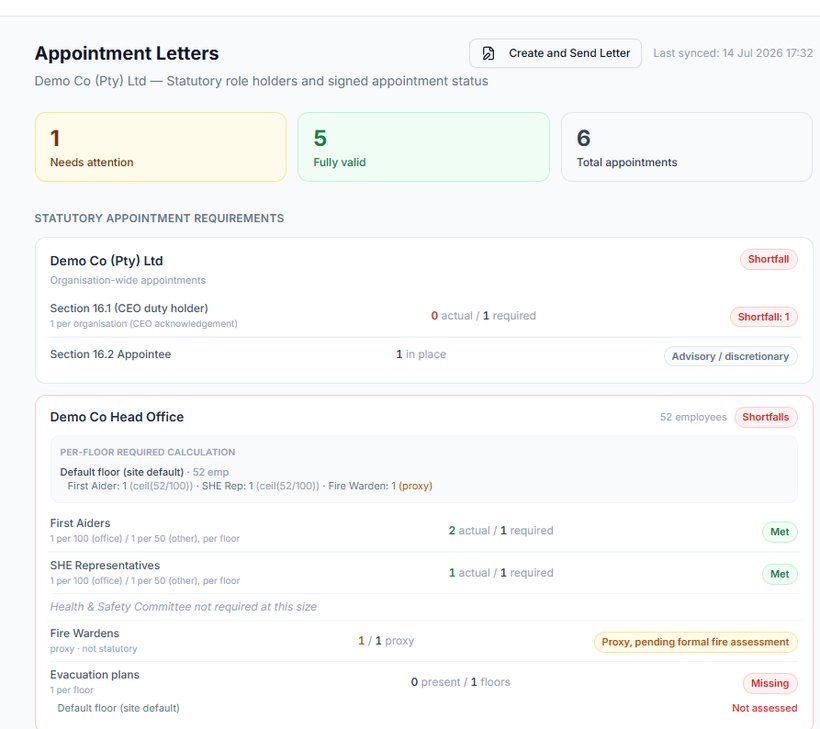
Statutory appointments tracked live: who is appointed, who is short, and a signed letter for each.
What we manage, and what stays with you
We manage: building your HIRA, drafting your statutory appointments, keeping your registers and framework current as obligations change, and reviewing everything before it is filed on your behalf.
You own: the facts about your sites and operations, implementing the physical controls on the ground, and the final approvals. We keep the record defensible; you run the business.
Further reading on these duties
We publish sourced analysis on South African occupational health and safety in Insights. The pieces below go deeper on the points above.
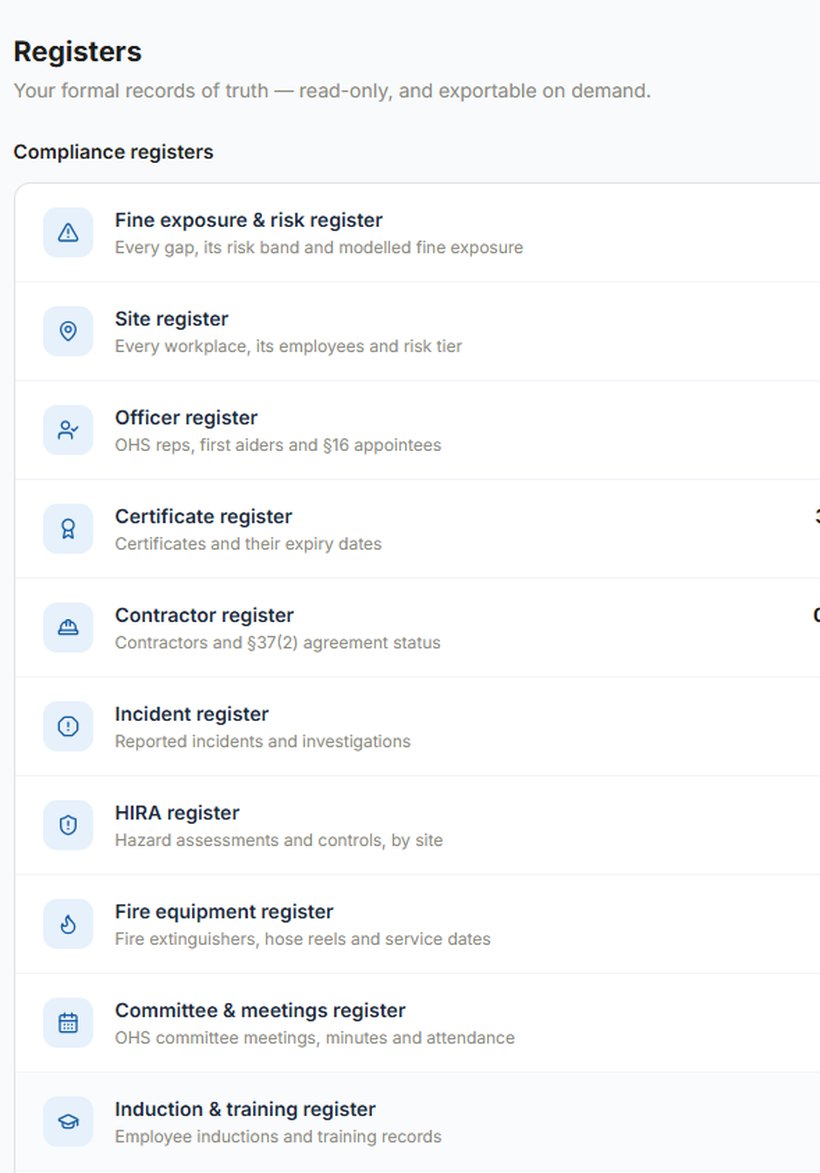
Your formal records of truth: read-only, always current, and exportable on demand.
OHS compliance FAQ
Does my business legally need an OHS management system?
Yes. Section 8 of the OHS Act requires every employer to provide a safe working environment as far as is reasonably practicable. If you employ more than 20 people you must also designate health and safety representatives, and establish committees where representatives are designated.
Is the OHS app software, or do you do the work?
Both. It is a managed service delivered through a platform. The software is your live compliance record; our team builds your risk assessments, drafts your statutory appointments, and a qualified human reviews what is filed on your behalf.
What does the OHS app actually produce?
A current HIRA hazard register, valid statutory appointment letters, COIDA tracking, incident records, contractor compliance, and audit-ready registers and reports.
How does it help during a Department of Employment and Labour inspection?
Your compliance record is current and centralised. Instead of digging through paper files, you show live appointment histories, risk registers and incident records from one place.
Is the health and safety representative ratio one for every 20 employees?
No. Section 17(5) of the OHS Act sets the ratio at one representative for every 100 employees or part thereof in shops and offices, and one for every 50 employees or part thereof in all other workplaces. The number 20 comes from section 17(1), which is the threshold at which the duty to designate representatives begins at all: more than 20 employees at a workplace. A workplace may run a richer ratio than the Act requires, either because that was agreed under section 17(2) and General Administrative Regulation 6, or because an inspector directed additional designations under section 17(6). That should be described as the agreed ratio rather than the statutory minimum.
How many first aiders does my workplace need?
General Safety Regulation 3(4) applies where more than 10 employees are employed, and then requires at least one person holding a valid first aid certificate of competency to be readily available during normal working hours for every group of up to 50 employees, or every group of up to 100 employees in the case of a shop or office. Separately, General Safety Regulation 3(2) requires a first aid box once there are more than 5 employees, which is a different and lower trigger. Because the requirement is availability during normal working hours, cover has to hold across shifts.
How long is a section 16(2) appointment valid for?
The OHS Act sets no general validity period for appointments. Section 17(1) designations of health and safety representatives are made for a specified period, and that period comes from the agreement reached under General Administrative Regulation 6. Other appointments run until they are withdrawn or the appointee leaves the role. Any commonly quoted fixed term such as two or three years is a management practice or an agreed term, not a figure taken from the Act. Reviewing appointments annually and on any organisational change is sound practice rather than a statutory deadline.
Does a section 16(2) appointment have to be in writing?
Section 16(2) does not use the words in writing. It says a chief executive officer may assign any duty contemplated in section 16(1) to a person under their control, and that person then acts subject to the CEO control and directions. Writing is how you prove the assignment happened, what its scope was, and that the appointee accepted it, which matters directly to the section 37(1)(c) defence that all reasonable steps were taken. So writing is strongly advisable and evidentially important, rather than an express requirement of that subsection. By contrast, section 17(1) and General Machinery Regulation 2(1) do expressly require writing.
Which incidents must be reported to the Department of Employment and Labour?
Section 24(1)(a) covers death, unconsciousness, loss of a limb or part of a limb, and any injury or illness serious enough that the person is likely to die, likely to suffer a permanent physical defect, or likely to be unable to work or continue the usual activity for at least 14 days. Section 24(1)(b) covers a major incident. Section 24(1)(c) covers dangerous substance spills, uncontrolled releases of substances under pressure, machinery fractures or failures producing flying, falling or uncontrolled objects, and machinery running out of control, where any person health or safety was endangered. The 14 day test is about likely inability to work, assessed at the time, not about how many days were actually taken off.
Does reporting under the OHS Act also lodge the COIDA claim?
No. They are separate duties with separate recipients. The OHS Act report goes to the provincial director of the Department of Employment and Labour on WCL 1 or WCL 2 within seven days. The COIDA report goes to the Compensation Commissioner or the licensed compensation insurer, and the employer must report within seven days after receiving notice of the accident. Since the 2026 amendments took effect, failure to report on the COIDA side attracts an administrative penalty, and the employee window to lodge a claim runs for three years from the accident.
Ready to start with OHS?
Tell us where you stand. We'll come back within two business days with a tailored scope.
The OHS Act compliance checklist
The OHS Act applies from your first employee. There is no headcount threshold on the section 8 general duty, and appointments, records and incident duties attach long before most employers think they do. Three regulation sets in this area were amended in 2025 and 2026, and one long standing set falls away on 6 September 2026, so a file written before that date needs rechecking. This checklist sets out the 33 things an inspector can ask you to produce, with the provision behind each one.
1. The general duty and the risk assessment
Section 8 sets the employer's general duty. Section 16 places the duty to see it discharged on the chief executive officer. Section 37 makes the employer presumptively liable for the acts and omissions of employees and mandataries.
- Establish and maintain a safe working environment
Provide and maintain, as far as is reasonably practicable, a working environment that is safe and without risk to health. Reasonably practicable is a defined term weighing severity, the state of knowledge, the availability of the means and the cost against the benefit. It is not as far as is convenient.
OHS Act s8(1) read with s1 - Carry out and keep a workplace risk assessment
Establish what hazards attach to the work, the plant, the machinery, the articles and the substances, and what precautionary measures are needed. This is the statutory basis for the risk assessment and it drives almost every other control you rely on.
OHS Act s8(2)(d) - Apply the hierarchy of control before issuing PPE
Take steps to eliminate or mitigate the hazard before resorting to personal protective equipment. PPE sits last in the statutory order, so a file that starts with PPE has skipped the part the Act asks about first.
OHS Act s8(2)(b) - Do not start work until the precautions are in place
Work and the operation of plant or machinery may not be permitted until the precautionary measures under 8(2)(b) and 8(2)(d) have been taken.
OHS Act s8(2)(f) - Put section 37(2) agreements in place with contractors
An employer and a mandatary may agree in writing on the arrangements and procedures between them to ensure compliance. Without it, the employer is presumed liable for the mandatary's acts and omissions and must prove all three limbs of the section 37(1) defence.
OHS Act s37(1) and s37(2) - Record the chief executive officer duty
Section 16(1) places on the chief executive officer the duty to ensure the employer's duties are properly discharged. It is not an appointment, it attaches automatically, and assigning it away does not relieve the employer of liability.
OHS Act s16(1) and s16(3)
2. Statutory appointments
Section 16(2) allows the chief executive officer to assign duties. Section 17(1) and General Machinery Regulation 2(1) create appointments that must expressly be in writing. The Act prescribes no form for an appointment letter, so its contents are drawn from the provisions read together.
- Assign section 16(1) duties to named people
The chief executive officer may assign any section 16(1) duty to a person under his or her control, who then acts subject to the officer's control and directions. Section 16(2) does not use the words in writing, but a written assignment is how you prove scope, acceptance and the reasonable steps required for the section 37(1)(c) defence.
OHS Act s16(2) - Designate a supervisor of machinery in writing
An employer or user of machinery must designate in writing a competent person in a full time capacity for every premises on or in which machinery is used. There is no headcount trigger, only a machinery trigger.
General Machinery Regulation 2(1) - Match the appointee's competency to installed power
Competency escalates with installed power. From 1 200 kW to 3 000 kW the person must fall into paragraphs (b), (c) or (d) of the competent person definition, and at 3 000 kW or more into paragraphs (c) or (d). Electricity generation and distribution premises are graded in kVA instead.
General Machinery Regulation 2(4) and 2(5) - Send the required appointments to the divisional inspector
Where the appointee falls under regulation 2(4)(a), 2(5)(b) or 2(5)(c), a copy of the letter of appointment must forthwith be forwarded to the divisional inspector. This step is missed more often than the appointment itself.
General Machinery Regulation 2(9) - Make each letter carry the eight things that matter
Name and identity number, the exact provision under which the appointment is made, the workplace or section covered, the duties assigned, the resources and authority given, the period, the date, and signature by both the appointing person and the appointee accepting.
s16(2), s17(1), GMR 2(1), GAR 9(2) - Review appointments rather than assume a renewal date
The Act sets no general expiry on an appointment. Commonly quoted two year or three year renewal cycles are management practice or an agreed term, not a figure from the Act. An appointment lapses in substance when the appointee leaves the role or the risk profile changes.
OHS Act s17(1), no general statutory expiry
3. Representatives and committees
Section 17 governs health and safety representatives and section 18 their functions. Section 19 governs committees and section 20 their functions and records. General Administrative Regulation 6 governs the consultation agreement and regulation 5 the meeting place and retention.
- Designate representatives above 20 employees
Where more than 20 employees are employed at a workplace, the employer must designate health and safety representatives in writing for a specified period, within four months, after consulting in good faith on the nomination or election process.
OHS Act s17(1) and GAR 6 - Apply the correct statutory ratio
One representative per 100 employees or part thereof in a shop or office, and one per 50 employees or part thereof in all other workplaces. The widely repeated one per 20 is not the statutory ratio. Twenty is the threshold at which the duty starts, not the ratio.
OHS Act s17(5) - Count employees per workplace, not per company
The thresholds attach to a workplace. A multi site employer assesses each site separately, so a business of 60 people across four small sites may trigger nothing while a single site of 21 does.
OHS Act s17(1) - Let representatives perform their statutory functions
Representatives may review the effectiveness of measures, identify hazards, examine incident causes with the employer, investigate employee complaints, make representations, inspect the workplace, participate in inspector consultations and attend committee meetings.
OHS Act s18(1) - Establish a committee once two representatives exist
Where two or more representatives have been designated at a workplace, one or more health and safety committees become mandatory, and the employer must designate the workplaces or sections each committee acts for.
OHS Act s19(1) - Keep employer nominees from outnumbering representatives
An employer may nominate members, but the number nominated may not exceed the number of health and safety representatives on that committee.
OHS Act s19(2) - Meet at least once every three months and keep the record
A committee must meet as often as necessary and at least quarterly. It must keep a record of every recommendation to the employer and every report to an inspector, and those records must be kept for at least three years.
OHS Act s19(4) and s20(2), GAR 5
4. First aid, safety equipment and the workplace environment
General Safety Regulation 3 governs first aid. Regulation 3(4) was amended on 5 December 2025. Regulations 13H, 13I and 13J were inserted on 6 March 2025. The Physical Agents Regulations, 2024 repeal the Environmental Regulations for Workplaces on 6 September 2026.
- Provide a first aid box above 5 employees
Where more than 5 employees are employed at a workplace, provide a first aid box or boxes at or near the workplace, accessible to employees, holding at least the Annexure minimum contents. The Annexure is a floor, not a ceiling.
General Safety Regulation 3(2) and 3(3) - Provide certificated first aiders above 10 employees
Where more than 10 employees are employed, at least one person holding a valid certificate of competency must be readily available during normal working hours for every group of up to 50 employees, or every group of up to 100 in a shop or office. Cover has to hold across shifts.
General Safety Regulation 3(4) - Check that your training provider is currently approved
The certificate must be issued by an organisation approved by the chief inspector. The 5 December 2025 amendment removed the historically named bodies from the wording, so confirm current approval rather than relying on a provider's past status. The common three year certificate currency comes from the qualification framework, not from regulation 3.
GSR 3(4) as amended by GN 6907, GG 53783 - Put up the regulation 3(6) notice
A prominent notice in a conspicuous place must show where the first aid box is kept and name the person responsible for it.
General Safety Regulation 3(6) - Meet the housekeeping, flooding and fire egress rules
Regulation 13H sets a minimum of 2,25 square metres of effective open floor area per employee indoors, plus unobstructed work spaces and protected floor openings. Regulation 13I covers flooding notice. Regulation 13J requires emergency doors opening outwards, at least two means of egress as far apart as practicable, and maintained firefighting equipment.
GSR 13H, 13I and 13J, inserted 6 March 2025 - Rewrite anything citing the 1987 Environmental Regulations
The Environmental Regulations for Workplaces, 1987 are repealed on 6 September 2026 by regulation 21 of the Physical Agents Regulations, 2024. Any file citing them for lighting, ventilation, thermal conditions, housekeeping, flooding or fire has a hard expiry date.
Physical Agents Regulations reg 21, GN 5952, GG 52226
5. Incident reporting, recording and investigation
Section 24 defines a reportable incident. General Administrative Regulation 8 sets the manner and period of reporting. General Administrative Regulation 9 governs recording and investigation. These are separate duties with separate triggers, and COIDA reporting is separate again.
- Know what makes an incident reportable
Report where a person dies, becomes unconscious, loses a limb or part of a limb, is likely to die or suffer a permanent physical defect, or is likely to be unable to work for at least 14 days. A major incident is reportable, as is a dangerous substance spill, an uncontrolled release under pressure, machinery fracture or failure, or machinery running out of control.
OHS Act s24(1) - Report on WCL 1 or WCL 2 within seven days
The employer or user of machinery must report to the provincial director on the prescribed form within seven days of the incident.
General Administrative Regulation 8(1)(a) - Notify serious incidents forthwith as well
Death, unconsciousness, loss of a limb or part of a limb, or an injury likely to result in a permanent physical defect must also be reported forthwith by telephone, facsimile or similar means. If an injured person later dies, notify forthwith.
General Administrative Regulation 8(1)(b) and 8(2) - Do not disturb the scene without an inspector's consent
The site of a serious incident may not be disturbed and articles or substances involved may not be removed, except so far as necessary to prevent a further incident, remove the injured or dead, or rescue persons from danger.
OHS Act s24(2) - Record every incident needing more than first aid
Record on Annexure 1 every section 24 reportable incident and every incident where a person required medical treatment other than first aid. Recording is a wider duty than reporting, and it is the one most often missed.
General Administrative Regulation 9(1) - Investigate within seven days and enter the findings
Every recorded incident must be investigated within seven days from the date of the incident, by the employer, a person appointed by the employer, a health and safety representative or a committee member. Findings go into Annexure 1 immediately after completion.
General Administrative Regulation 9(2) and 9(3) - Take the records to the committee and keep them three years
The health and safety committee must consider the records at its next meeting and the employer must implement and follow up the necessary actions. Annexure 1 records are kept at the workplace, open to an inspector, for at least three years.
GAR 9(4) and GAR 9(1) - Report to the Compensation Fund separately
OHS Act reporting goes to the provincial director for enforcement. COIDA reporting goes to the Commissioner or your licensed insurer for compensation. Reporting to one does not discharge the duty to the other. Since the 2022 Amendment Act commenced in 2026, the claim prescription period has been extended from 12 months to three years.
COIDA, as amended by Act 10 of 2022
What non-compliance costs
- Section 38(1): a fine not exceeding R50 000, or imprisonment not exceeding one year, or both. This covers failure to comply with sections 8, 12 to 20, 24 and others, and failure to comply with an inspector's direction or notice.
- Section 38(2): where an act or omission caused injury in circumstances where the employer would have been guilty of culpable homicide had death resulted, a fine not exceeding R100 000, or imprisonment not exceeding two years, or both.
- Section 38(3): in addition to any punishment, the court may order compliance with the breached provision within a period it determines.
- Individual regulations carry their own higher penalties. The Major Hazard Installation Regulations, 2022 provide for R500 000 to R5 000 000 or imprisonment up to 24 months. Do not rely on a single maximum fine figure without knowing which instrument it comes from.
- Each contravention is a separate offence and the Act expresses its maximum per offence on conviction, so several contraventions compound. Treat any total built that way as a modelled worst case rather than a legal statement, and note that an inspector issues notices and refers for prosecution rather than levying a fine. A single inspection that finds a missing risk assessment, no designated representatives, no committee and unrecorded incidents is four contraventions, not one.
Get the checklist as a PDF, or have us run it for you
Same content as above, laid out as a working document with tick boxes so you can walk it with your team. Leave your details and the PDF downloads straight away. OHS is live now, so if you would rather we ran it for you than work the list yourself, leave your details and we will come back to you within two business days.
We use your details to send the checklist and to tell you when the OHS app is available. We do not sell or share your details. You can ask us to delete them at any time by emailing [email protected]. This checklist is general information about published law, not legal advice, and GRC Shop is not a law firm.
Go deeper on a specific duty
Each guide sets out one duty in full, with the section or regulation behind every requirement and the thresholds stated as the gazette words them.
Statutory appointments
Which appointments the Act requires in writing, what a defensible letter contains, and why the renewal cycles everyone quotes are not in the Act.
Read the OHS statutory appointments guideHealth and safety representatives
The more than 20 trigger, the real section 17(5) ratio, and why one per 20 is not what the Act says.
Read the health and safety representatives guideFirst aiders and first aid boxes
Two different triggers, the shop and office ratio most sources drop, and where the three year certificate rule actually comes from.
Read the first aiders and first aid boxes guideHealth and safety committees
When a committee becomes mandatory, who may sit on it, the quarterly meeting duty, and the records that must survive three years.
Read the health and safety committees guideIncident reporting and investigation
Reporting and recording are separate duties with separate clocks. Seven days to report, seven days to investigate, three years to retain.
Read the incident reporting and investigation guideTalk to us about your OHS compliance
Tell us where you are exposed and we will come back to you within two business days. No obligation.